Search is changing, and with it, the meaning of online authority.
For years, businesses working on SEO have followed a familiar formula. Publish useful content, optimise pages around relevant searches, and earn links from other websites. The stronger the backlink profile, the better the chances of being seen as an authoritative source.
That approach still matters for conventional search, but the rise of ChatGPT, Gemini, Claude and other large language models is creating another challenge altogether.
It is no longer enough to ask: “How do we rank on Google?”
Brands increasingly need to consider: “How does an AI system know that we are credible enough to mention?”
Research published by NP Digital in August 2026 offers an interesting glimpse into how marketers believe that answer is changing. The study surveyed 1,000 marketers about the signals they consider important when building brand authority for large language models, or LLMs.
Some of the results look familiar. Others challenge several long-held assumptions about SEO.
Customer reviews came out on top
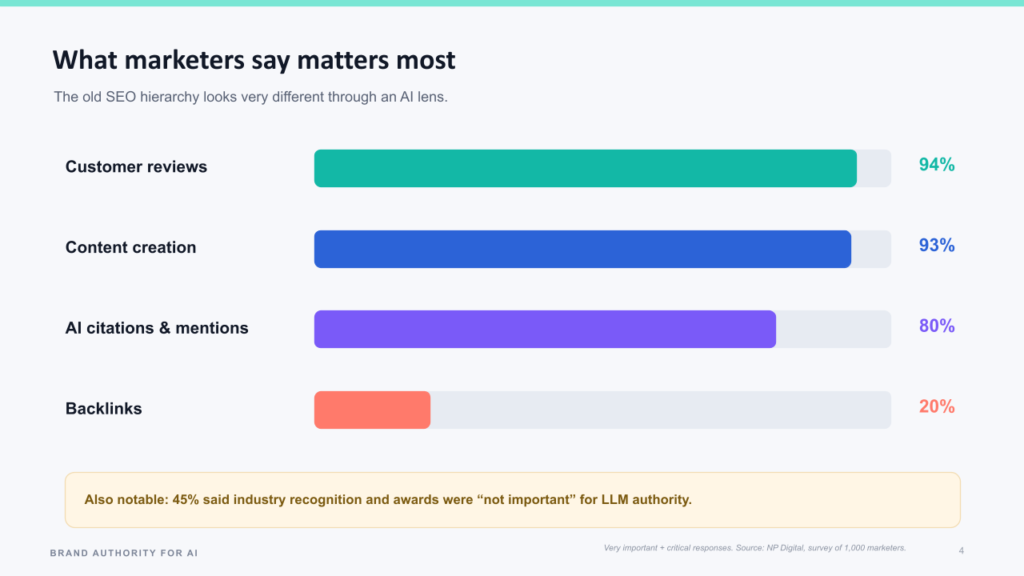
Perhaps the clearest finding was the importance placed on genuine customer feedback. Some 94% of marketers surveyed described customer reviews as either very important or critical to building authority with LLMs. More strikingly, 82% placed them in the critical category.
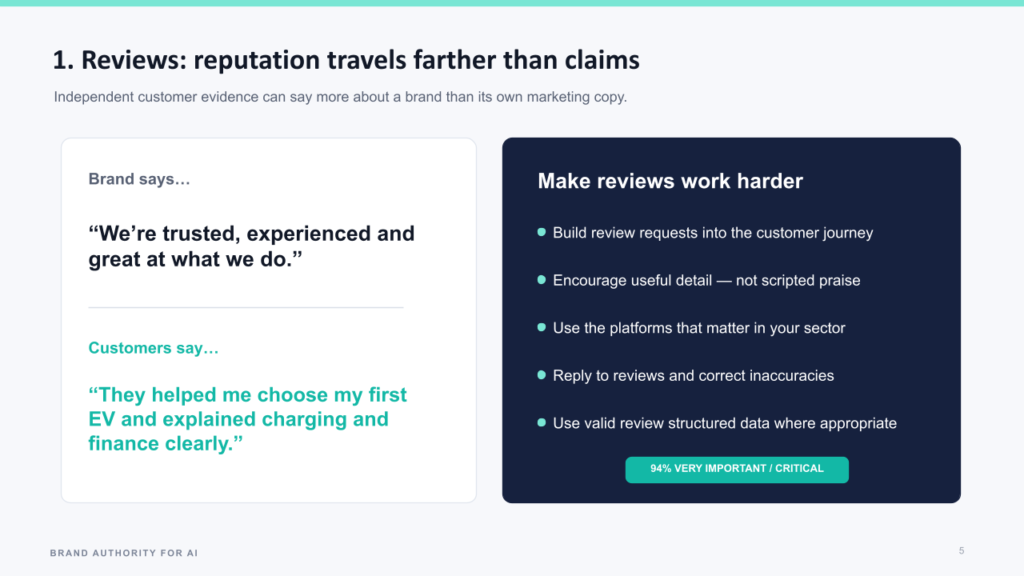
That makes sense when you consider what a review represents. A brand can say almost anything about itself. A company can describe itself as trusted, experienced, reliable or the market leader on its own website. Independent customers saying those things is different.
Reviews create outside evidence that the business exists, serves real customers, and has developed a reputation beyond its own marketing material. For brands thinking about AI visibility, review generation therefore deserves more attention than simply chasing a higher star rating.
The aim should be to build a broad and genuine picture of customer experience across relevant third-party platforms as well as your own website. Detailed reviews are particularly useful because they naturally connect the business with products, services, locations and customer needs.
A review saying: “Great company,” provides very little context. One saying: “I used this company to buy my first electric car and they explained home charging, battery range and finance clearly,” contains far more useful information about what the company actually does.
Content still matters — but volume alone isn’t enough
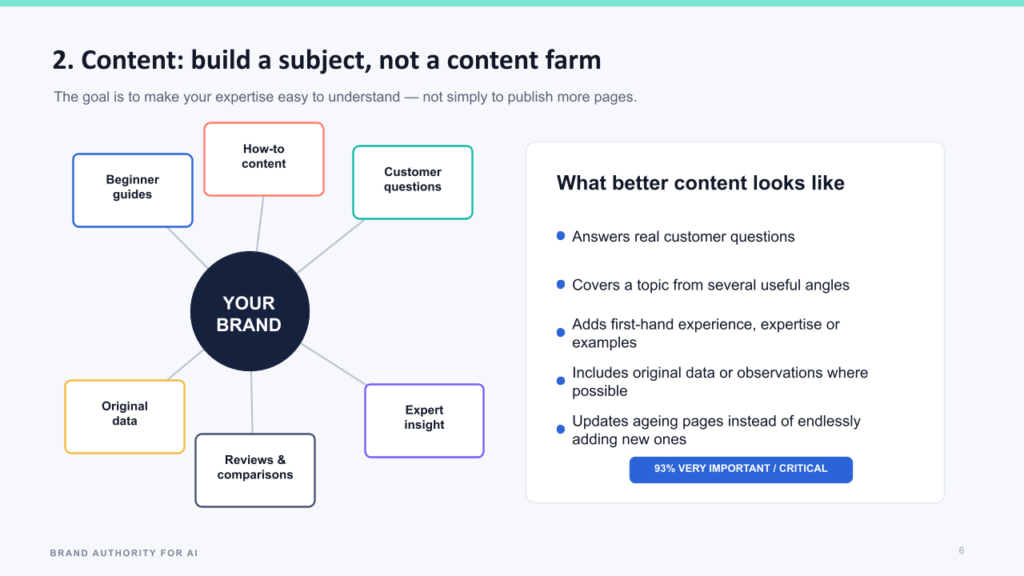
Content creation followed closely behind reviews. The study found that 93% of marketers considered content creation very important or critical to LLM authority, with 64% describing it as critical. Anyone hoping this means publishing 300 generic AI-written articles a month is likely to be disappointed. The more useful interpretation is that content helps establish what a brand knows about.
Consider a website that regularly produces genuinely useful material around electric cars. It might answer questions about battery degradation, charging costs, winter range, home charging, used EV values and long-distance journeys. Over time, the relationship becomes increasingly clear:
Brand → electric vehicles → expertise.
That relationship is potentially valuable when an AI system needs information about electric cars. This is one reason topical depth matters. Rather than jumping between unrelated subjects simply because a keyword tool shows search volume, businesses should build recognisable areas of expertise. Create clusters of content that answer the questions customers genuinely ask.
Cover the subject from different angles. Update older material when necessary. Add experience, examples, original observations and proprietary data wherever possible. The objective is not simply to have more pages. It is to leave fewer doubts about what your brand knows.
AI mentions are becoming a metric of their own
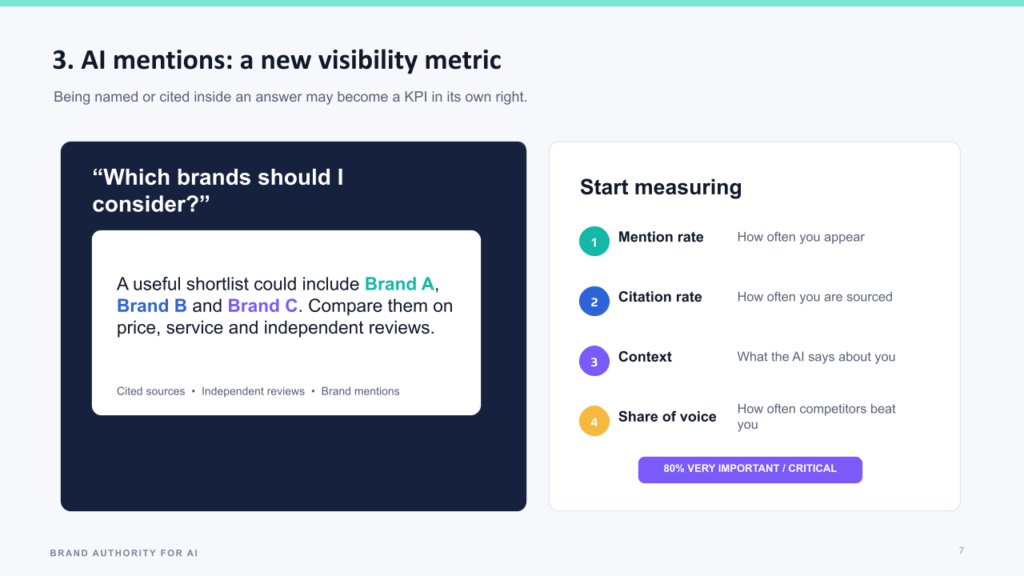
Another notable finding concerns citations within AI-generated answers. Some 80% of marketers surveyed regarded AI citations and mentions as either very important or critical. That introduces an entirely new type of visibility measurement.
Historically, SEO reporting has focused heavily on things such as:
- Google rankings
- organic traffic
- impressions
- backlinks
- click-through rates
- conversions
Those metrics remain useful. But marketers may increasingly need to ask another question: “Does ChatGPT mention us?” The same applies to Gemini, Claude, Perplexity and whatever other AI discovery tools become important to customers. This could eventually make AI share of voice almost as useful as traditional search visibility.
Brands should start testing relevant customer questions across major AI platforms. If you sell accounting software, for example, ask which accounting platforms are recommended for small UK businesses. If you operate a used car website, test questions such as: “What are the best places to buy a used electric car in the UK?”, “What should I check when buying a second-hand EV?”, “Which companies specialise in used electric cars?”
Look at which companies repeatedly appear. Then investigate why.
The big surprise: backlinks performed poorly
This is where the research becomes particularly interesting for anyone working in SEO.
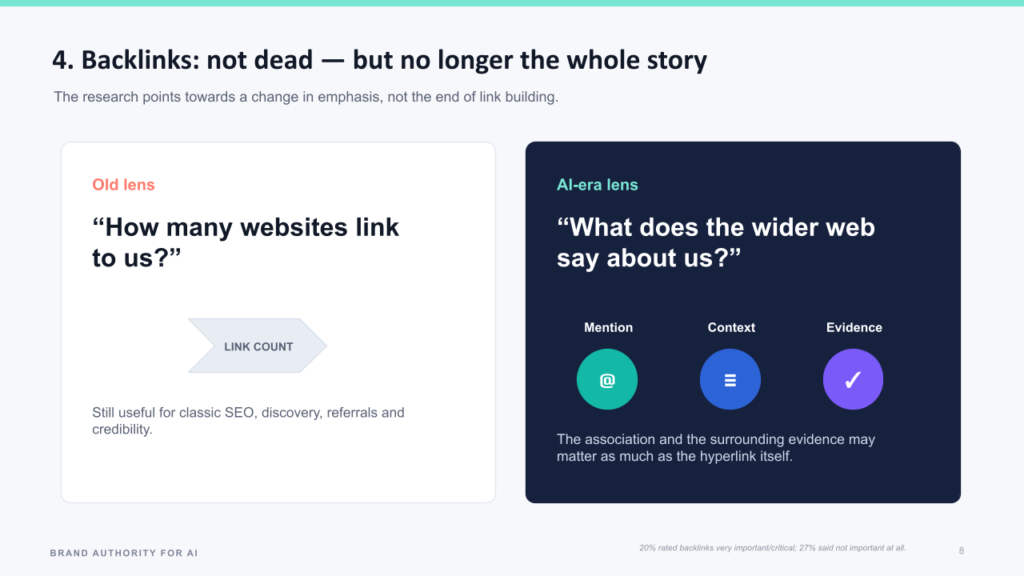
Only 20% of surveyed marketers described backlinks as very important or critical for LLM brand authority. Meanwhile, 27% said backlinks were not important at all. That is a dramatic contrast with traditional SEO, where links have spent decades occupying a central place in authority building.
It would, however, be a mistake to translate this finding into: “Backlinks are dead.” They aren’t. Links remain relevant to conventional search and can still help with discovery, referral traffic, relationships, credibility and Google rankings. What may be changing is the purpose of outreach. A mention inside a genuinely relevant article could potentially be valuable even when the primary goal isn’t PageRank.
Imagine a respected electric vehicle website discussing the best places to buy a used EV and mentioning your company because it has a particularly large selection. From a traditional SEO perspective, you might immediately ask: “Did they link to us?” From an AI visibility perspective, another question becomes equally interesting: “What did they say about us?”
That changes the mindset considerably. The link itself may only be part of the value. The association between the brand and the subject could matter too.
Brand mentions could become more important than link counts
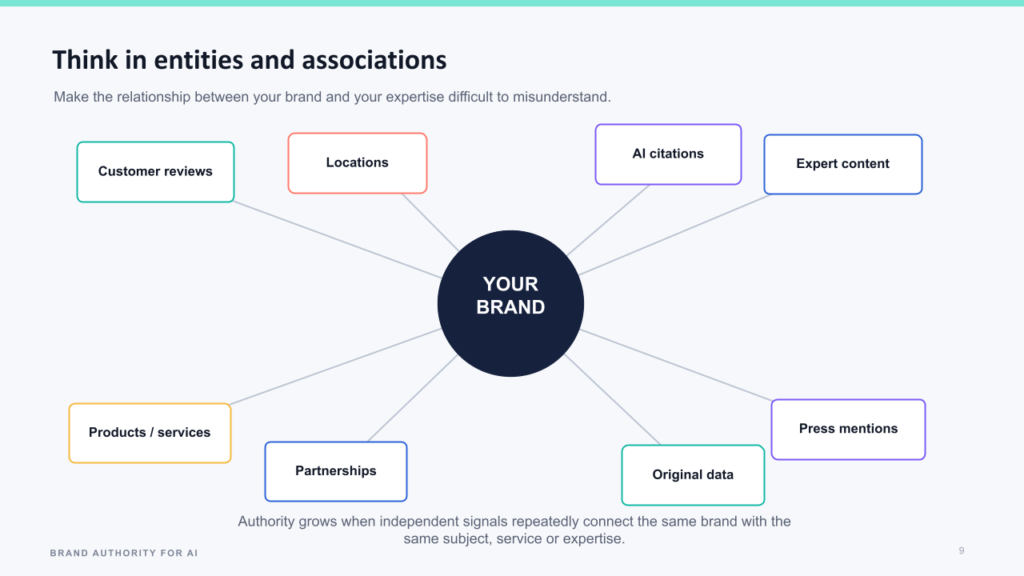
This leads into the wider idea of entity recognition. An entity is simply something identifiable: a person, company, product, organisation, location or brand. Search engines and AI systems increasingly try to understand the relationships between those entities.
For example:
Nike → sportswear
Tesla → electric vehicles
Tripadvisor → travel reviews
MoneySavingExpert → personal finance
Those associations have been reinforced countless times across websites, articles, reviews, databases, discussions and other sources. Smaller brands should be trying to create the same clarity within their own market. That doesn’t mean repeating the same keyword next to your company name thousands of times. It means developing genuine evidence connecting the business with its specialist subject.
Third-party articles can contribute. Customer reviews can contribute. Original research can contribute. Expert commentary can contribute. Industry publications can contribute. Relevant partnerships can contribute. Even discussions on forums and communities may help establish wider context around a brand.
The important part is consistency.
Don’t confuse survey results with an AI ranking formula
There is one important limitation to the research. These figures do not reveal the internal ranking algorithm used by ChatGPT, Gemini or another LLM. NP Digital surveyed 1,000 marketers and asked how important they considered different authority signals. There isn’t a secret ChatGPT score in which reviews are worth 94 points while backlinks receive 20.
The study is better viewed as evidence of how experienced marketers believe digital authority is evolving. It highlights a shift in priorities rather than exposing a confirmed ranking system. That distinction matters.
Generative engine optimisation, sometimes called GEO, remains a relatively young discipline. Anyone claiming to know the exact formula for becoming the number-one recommendation in ChatGPT should be treated with caution.
AI visibility will continue evolving alongside the systems themselves.
What should businesses actually do?
The sensible response isn’t to throw away everything learnt from SEO. It is to widen the strategy.
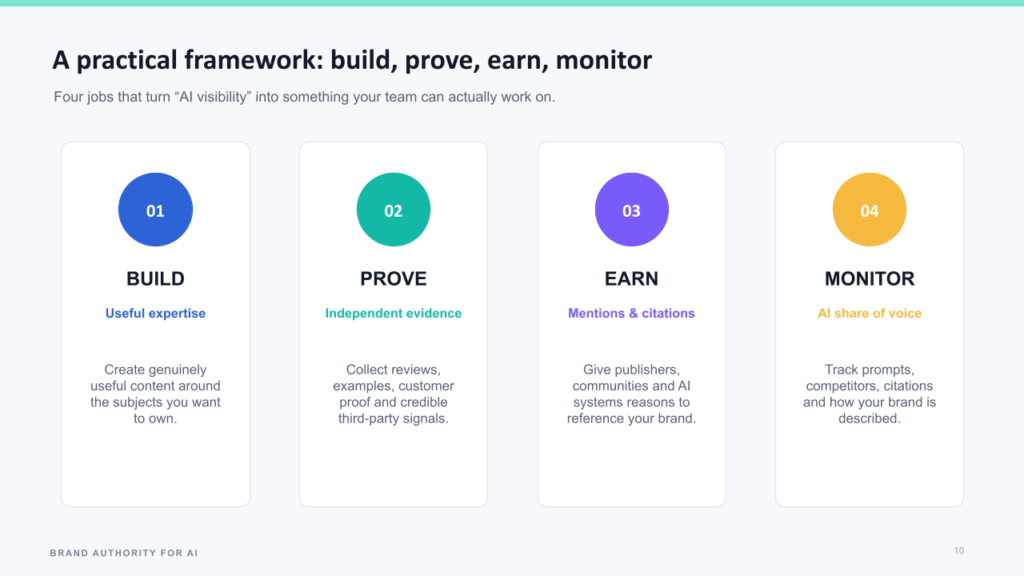
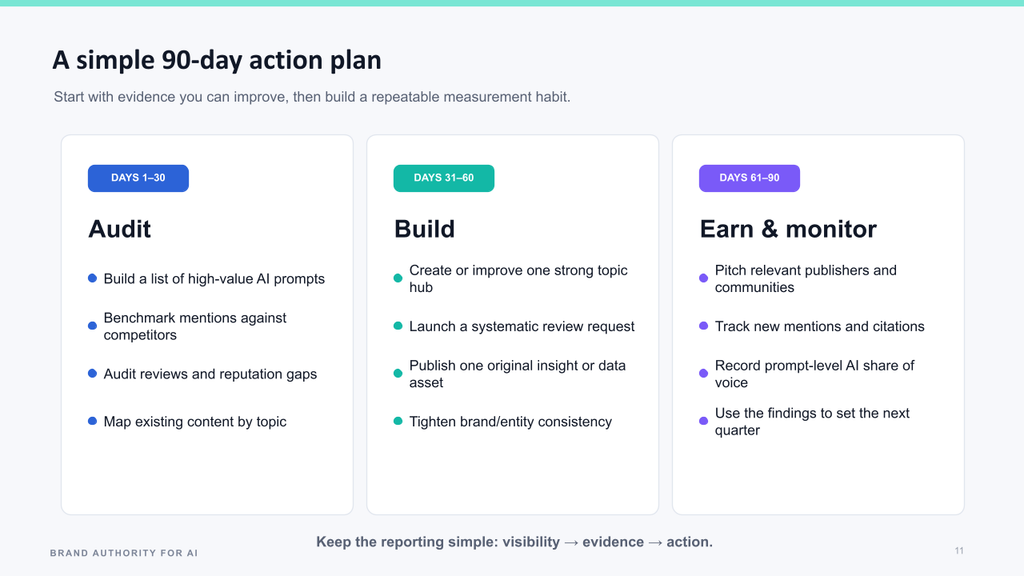
Start with your reputation. Encourage customers to leave genuine reviews on the platforms that matter within your industry. Don’t manufacture them and don’t chase meaningless volume. Aim for authentic feedback that describes real experiences.
Then examine your content. Does your website clearly demonstrate what you specialise in? Could someone unfamiliar with your company understand your expertise after reading several pages? Look for gaps where customers frequently ask questions but you have little useful material answering them.
Next, start thinking beyond your own website. Seek opportunities for your brand, employees, research and expertise to appear within relevant publications and communities. Guest contributions can still play a role, but the goal should be something more meaningful than obtaining another hyperlink. A useful mention from a relevant website can establish context, reputation and subject association while potentially earning a link at the same time.
Original research is particularly valuable. Surveys, proprietary statistics, internal data and genuinely useful studies give journalists, bloggers and other websites something worth referencing. They also create information that AI systems may eventually cite when answering questions.
Finally, start monitoring AI visibility. Create a set of prompts representing the questions potential customers might ask during research or purchasing. Run those periodically through major AI platforms. Record which brands appear, which sources are cited and how your own brand is described. The result can reveal gaps that conventional keyword ranking reports never show.
SEO isn’t disappearing. Authority is getting broader.
The biggest mistake marketers could make now is treating SEO and AI optimisation as completely separate disciplines. There is significant overlap.
Good content still matters. Reputation matters. Technical accessibility matters. External coverage matters. Brand recognition matters. Links still have value.
What appears to be changing is the weight placed on each signal and the way authority is understood. For years, marketers have spent enormous amounts of energy trying to convince Google that a website deserves to rank. AI adds another challenge.
Businesses now need to make their expertise sufficiently clear across the wider web that machines can understand not just where the company appears, but what it should be associated with.
That requires a broader approach to digital authority. Don’t simply ask how many websites link to your business. Ask how often your brand is discussed. Ask what customers say about it. Ask whether independent websites associate it with your area of expertise. Ask whether your content contains information worth referencing. And increasingly, ask whether AI systems know who you are at all.
Because the next battle for search visibility may not be reaching position one. It may be becoming one of the names AI thinks is worth mentioning.